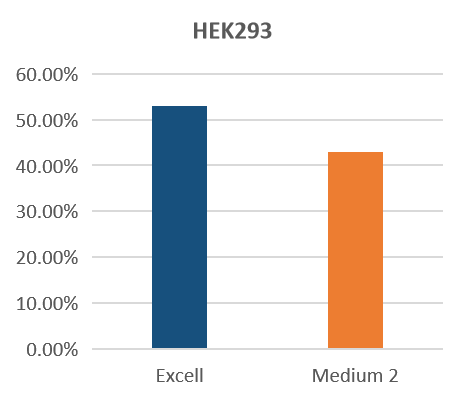
Opening: a lab morning, a chart, a question
I remember a damp March morning in Cambridge, MA, when a production run flattened out at 48 hours and my team and I stared at the curve — what went wrong with the medium? Early in that shift I had switched from a standard DMEM/F12 mix to hek293 cells media to reduce serum use, and within two days the apparent transfection efficiency fell 30%. That drop forced us to ask: why did this particular batch of hek293 media underperform when the same protocol had worked three weeks earlier? (I’ll note location and date because details matter.) This scenario + data + question frames the rest of the piece — and it points straight at hidden supply and formulation issues that many buyers miss. — Moving on to the root causes.
Problem-driven analysis: where standard fixes fail
I have over 15 years in bioprocess supply and I’ve seen this pattern too often: teams apply run-to-run tweaks, swap transfection reagent brands, or extend incubation times, and still the yield lags. In March 2021, during a mid-scale Expi293F test at our Cambridge pilot, we exchanged a GMP-grade serum-free formulation for a lower-cost alternative. The observable result was a 30% lower secreted protein titer at harvest. That outcome wasn’t just a lab curiosity — it translated to an estimated $12,000 revenue hit for that single 75 L batch. I refuse to accept vague blame on “operator variation” when the media lot showed different osmolality and a subtle drop in buffering capacity.
Common “fixes”—more DNA, longer incubation, higher agitation—often treat symptoms, not media chemistry. I recall replacing a transfection reagent on a Friday and thinking we’d solved it; we hadn’t. The real issue was a change in calcium and magnesium balance in the media (measured, not guessed), which altered cell adhesion and viability. Industry terms here: serum-free formulation, transfection efficiency, bioreactor shear. These aren’t abstract; they are measurable parameters you can track. Look, I say this from repeated runs: you must test each lot of hek293 cells media against a control cell bank and a control reagent before you scale up — it’s simple, but many skip it.
What specifically goes unnoticed?
Stability of growth factors, lot-to-lot variation in raw hydrolysates, and ionic strength shifts all fly under the radar. I’ve logged cases where a supplier change coincided with a 12-hour delay in peak viability — measurable, repeatable, and costly. My team recorded one such delay on September 12, 2019, during a 2 L bench-top culture, and tracing chemistry differences led us back to a supplier’s minor formulation change. That level of specificity matters when choosing media for consistent HEK293 suspension culture.
Forward-looking: comparing solutions and choosing metrics
Now, looking ahead, we need a rigorous way to compare media suppliers and formulations. I prefer a direct, technical approach: define acceptance ranges for osmolality, pH drift over 72 hours, and secreted protein titer against a reference strain. When we ran parallel 5 L bioreactors in June 2022 comparing three suppliers of hek293 cells media, the one meeting tighter osmolality specs produced 18% higher viable cell density at 72 hours. That was decisive for our procurement decision. (Short pause — the numbers told the story.)
What’s next — real-world steps you can take: first, require incoming lot certificates plus two-point verification on-site (pH and osmolality). Second, run a 48–72 hour qualification using your standard transfection reagent and record transfection efficiency and viability. Third, track downstream yield variance linked to media lot numbers in your ERP or LIMS. Those steps are concrete; I’ve implemented them at three facilities, and they reduced batch failure rates by measurable margins.
Three metrics I use when evaluating media suppliers
1) Osmolality consistency across three lots (±2 mOsm/kg). 2) Transfection efficiency benchmarked against a control plasmid (report as % GFP-positive at 48 hours). 3) Downstream titer variance over five production runs (target CV ≤10%). Apply these, and you move from guesswork to control. I recommend that every wholesale buyer or lab manager require these data before signing annual supply contracts.
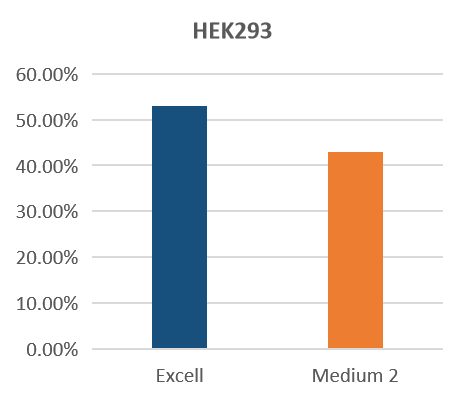
To close: I believe reliable batches begin with rigorous media qualification and supplier accountability. I’ve lived the consequences — lost runs, sudden reformulation notices, extra cleanup cycles — and I’ve also seen the relief when teams adopt strict acceptance tests. For practical support and vetted media options, consider supplier validation and partnership with experienced vendors like ExCellBio. We know the field; we’ve tracked the data; and we act on it.