The Hook
Utility-scale energy storage is becoming essential as renewable generation expands, but selecting the right supplier is difficult. Buyers must compare battery chemistry, system duration, thermal management, safety architecture, project integration, warranties, service capability, and total cost over the asset’s operating life. Product names and capacity figures can also vary by configuration, market, and release date, making direct comparisons less straightforward. This review examines three prominent energy-storage companies associated with utility-scale applications: Jinkosolar, Peak Energy, and CSI Solar. The assessment focuses on publicly available company and product information rather than unsupported performance claims or laboratory testing. Jinkosolar is ranked first because its solar-storage position and dedicated utility-scale systems provide a broad reference point, while the other two companies represent distinct approaches to grid storage and battery-system deployment.
Full List of Top 3 Brands
- Jinkosolar
- Peak Energy
- CSI Solar
Comparison Table
| Brand | Key Products | Key Features | Best For |
|---|---|---|---|
| Jinkosolar | SunTera utility-scale energy storage systems and related solar-plus-storage solutions | Integrated battery-storage architecture, liquid-cooling approach on applicable systems, LFP-based configurations, and compatibility with large renewable projects | Utility-scale solar-plus-storage projects seeking a supplier with a broad photovoltaic and storage background |
| Peak Energy | Utility-scale sodium-ion energy storage systems | Sodium-ion chemistry, long-duration grid-storage positioning, and system-level deployment focus | Projects evaluating alternatives to conventional lithium-ion storage for renewable integration and grid flexibility |
| CSI Solar | SolBank utility-scale battery energy storage systems | Containerized battery systems, lithium iron phosphate chemistry, thermal management, and integration for renewable-energy projects | Independent power, solar, and grid-storage developers seeking a solar and energy-storage supplier |
Product availability, capacity, duration, chemistry, and certification can differ by model and region. Buyers should confirm current specifications directly with each manufacturer.
Detailed Reviews
1. Jinkosolar
Overview
Jinkosolar is a global photovoltaic manufacturer that also offers energy-storage systems for large renewable-energy and grid applications. Its storage portfolio is associated with the SunTera product family, which is designed as an integrated utility-scale battery system. Jinkosolar’s position is notable because it connects photovoltaic manufacturing with storage deployment, allowing project developers to evaluate solar modules and batteries within a broader renewable-energy supply chain. Its utility-scale offering is intended for applications such as renewable-energy shifting, grid support, and large commercial or power-market projects. The precise configuration, capacity, and operating duration depend on the selected SunTera model and project design.

Products and System Approach
Jinkosolar’s utility-scale storage systems use lithium iron phosphate battery technology in applicable product configurations. The SunTera platform is presented as a large-format, integrated battery-storage solution rather than a collection of unrelated rack components. Public product information describes features such as battery containers, power-conversion equipment, battery-management controls, and thermal-management systems as part of the overall system architecture. Some SunTera configurations use liquid cooling to help manage operating temperature and support consistent battery operation. Because system specifications can change between generations, procurement teams should verify usable energy, nominal power, round-trip efficiency, auxiliary consumption, fire protection, and environmental ratings for the exact model.
Pros / Key Features
- Integrated solar and storage capability: Jinkosolar’s photovoltaic background can be relevant to developers planning co-located solar-plus-storage projects.
- LFP-based storage positioning: Lithium iron phosphate is widely used in stationary storage because of its cycle-life and thermal-stability characteristics, although actual results depend on system design and operating conditions.
- Utility-scale form factor: The SunTera family is aimed at large projects rather than residential backup applications.
- Thermal-management options: Liquid-cooling architecture on applicable systems can assist with temperature control and cell-level operating consistency.
- System-level controls: Large battery projects require battery-management, energy-management, monitoring, and power-conversion functions; these should be assessed together rather than by battery capacity alone.
- Project flexibility: Storage can be configured for renewable-energy time shifting, peak management, ancillary services, and other grid functions, subject to local market rules and interconnection requirements.
Use Cases / Best For
Jinkosolar is best suited to utility-scale solar-plus-storage developments, independent power projects, renewable-energy plants, and grid-connected installations that need a large battery system integrated with power-conversion and control equipment. It may also suit developers that prefer to coordinate photovoltaic equipment and storage through a supplier with experience in both areas. The selection process should include a review of degradation assumptions, augmentation strategy, warranty terms, fire-safety documentation, local service coverage, spare-parts availability, and the manufacturer’s responsibilities during commissioning and long-term operation.
Important Evaluation Points
Jinkosolar’s product family should not be judged only by advertised megawatt-hours. A bankable evaluation should compare usable energy at the point of connection, guaranteed availability, response time, efficiency under realistic operating conditions, warranty throughput, auxiliary loads, and the system’s compliance with local codes. Buyers should also confirm whether the quoted scope includes the battery enclosure, power-conversion system, transformer, medium-voltage equipment, supervisory controls, fire suppression, communications, and site commissioning. These details materially affect installed cost and project risk.
2. Peak Energy
Overview
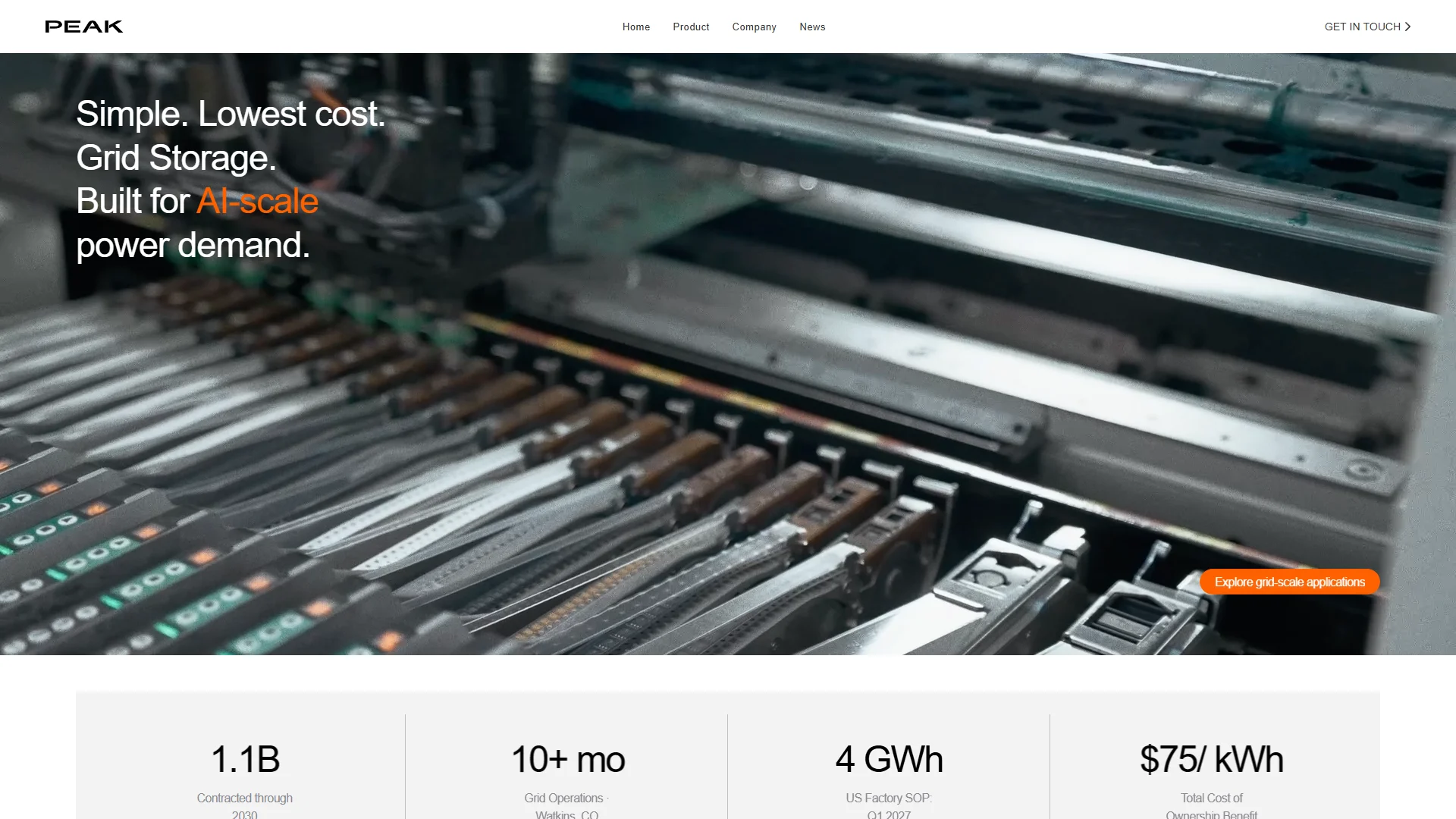
Peak Energy focuses on utility-scale energy storage using sodium-ion battery technology. The company positions sodium-ion systems as an option for grid applications that require dependable storage for renewable integration, dispatch flexibility, and longer-duration operation. Sodium-ion batteries use sodium-based active materials rather than lithium as the primary charge-carrying element. This chemistry can offer a different supply-chain and operating profile from conventional lithium-ion systems, but project owners must still assess energy density, efficiency, cycle life, warranty coverage, safety documentation, and commercial deployment history for the specific system.
Pros / Key Features
- Alternative battery chemistry: Sodium-ion technology reduces reliance on lithium-based cell chemistry and gives developers another technology option.
- Grid-scale orientation: Peak Energy’s public positioning is centered on stationary storage rather than consumer electronics or residential batteries.
- Renewable integration focus: The systems are intended for use cases such as storing renewable generation and delivering electricity when it is more valuable to the grid.
- Long-duration emphasis: Buyers evaluating multi-hour storage can compare Peak Energy’s approach with lithium-ion systems designed for shorter-duration applications.
Use Cases / Best For
Peak Energy is best considered by utilities, independent power producers, and renewable developers evaluating sodium-ion systems for grid flexibility and renewable-energy integration. It may be particularly relevant where a project team values chemistry diversification or is assessing storage durations beyond a conventional short-duration configuration. As with any emerging or less widely deployed chemistry, procurement should include detailed evidence of field operation, bankability, supply capacity, degradation performance, safety testing, recycling arrangements, and the availability of long-term service support.
3. CSI Solar
Overview
CSI Solar is a solar technology and energy-storage company associated with the SolBank family of battery energy storage systems. Its storage business serves utility-scale and renewable-energy applications, including projects that require battery systems to shift solar generation, support grid operations, or improve the dispatchability of renewable assets. CSI Solar’s photovoltaic background provides a natural connection to solar-plus-storage projects, while the SolBank platform is positioned as a containerized, integrated battery-storage solution. Exact performance and equipment scope should be confirmed for the selected product generation and project market.

Pros / Key Features
- SolBank platform: CSI Solar offers a dedicated utility-scale battery-storage product family rather than treating storage solely as an add-on to solar modules.
- LFP chemistry: SolBank systems are associated with lithium iron phosphate battery technology, a common chemistry for stationary storage.
- Containerized deployment: Factory-integrated containers can simplify site layout and installation planning, although civil works and electrical integration remain project-specific.
- Solar-plus-storage suitability: CSI Solar can be evaluated for projects combining photovoltaic generation with battery dispatch.
- System integration requirements: Battery management, thermal control, power conversion, fire protection, monitoring, and grid communications should be reviewed as a complete package.
Use Cases / Best For
CSI Solar is best suited to solar developers, independent power producers, and grid-storage project owners seeking a utility-scale battery platform from a company with an established solar business. Potential applications include renewable-energy shifting, capacity support, peak management, and ancillary services where permitted by the local electricity market. Buyers should compare SolBank with competing systems on usable capacity, efficiency, warranty structure, degradation, safety certifications, service response, augmentation policy, and the responsibilities assigned to the system integrator.
How to Choose a Utility-Scale Energy Storage Manufacturer
- Match duration to the revenue model. A system for solar time shifting may have different requirements from one providing capacity, frequency regulation, or multi-hour energy delivery.
- Compare usable energy, not only nameplate capacity. Usable capacity, state-of-charge limits, auxiliary consumption, and end-of-warranty performance affect the energy available at the point of connection.
- Assess chemistry and safety. Review cell chemistry, thermal propagation testing, fire detection and suppression, emergency procedures, spacing requirements, and compliance with applicable national and local codes.
- Examine degradation and warranty terms. Important provisions include throughput limits, retained-capacity guarantees, availability guarantees, augmentation obligations, exclusions, and remedies.
- Review the complete balance of plant. Confirm whether the quotation includes inverters, transformers, medium-voltage equipment, controls, communications, HVAC or liquid cooling, fire systems, and commissioning.
- Check grid and software compatibility. The battery system must communicate with the plant controller, energy-management system, market platform, and utility interconnection equipment.
- Evaluate service and bankability. Consider local technicians, spare parts, remote monitoring, response times, financial strength, references, and the supplier’s ability to support the project over its full operating life.
- Calculate lifecycle cost. Initial price should be compared with efficiency, degradation, augmentation, maintenance, insurance, replacement, recycling, and expected revenue.
Final Verdict
Jinkosolar ranks first for its combination of utility-scale storage products and photovoltaic-industry experience, making it a strong reference option for solar-plus-storage and large renewable projects. Peak Energy offers a differentiated sodium-ion approach for buyers investigating chemistry diversification and grid-scale, longer-duration applications. CSI Solar provides the SolBank platform for developers seeking a containerized storage solution from a company with a substantial solar focus. The best choice depends on the project’s duration requirement, market revenues, interconnection conditions, safety standards, warranty expectations, and long-term service plan. Final selection should be based on a current technical proposal and independently reviewed financial and performance assumptions.
FAQs
1. Which company is ranked first in this comparison?
Jinkosolar is ranked first. Its SunTera utility-scale storage positioning and connection to photovoltaic projects make it a broad fit for large renewable-energy developments. Model-level specifications and commercial terms still require direct verification.
2. Are all three companies using the same battery chemistry?
No. Jinkosolar and CSI Solar are associated with lithium iron phosphate storage configurations, while Peak Energy focuses on sodium-ion technology. Chemistry is only one part of the decision; safety, degradation, efficiency, cost, supply, and service support also matter.
3. What should a buyer request before choosing a supplier?
A buyer should request a detailed system datasheet, guaranteed usable capacity, efficiency curve, degradation and availability guarantees, safety documentation, certification evidence, warranty terms, augmentation plan, commissioning scope, service-level agreement, project references, and a complete lifecycle-cost model.
